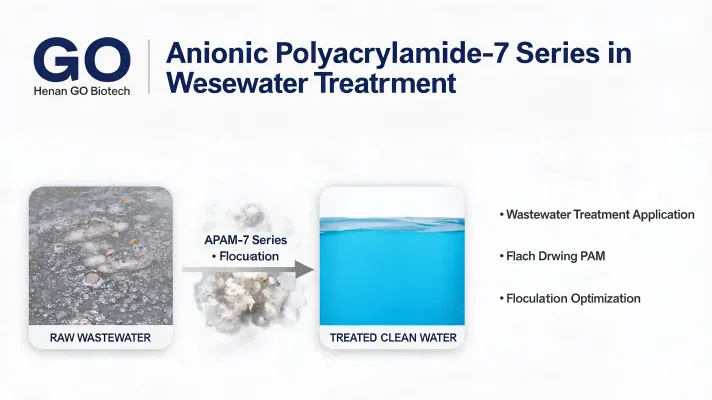
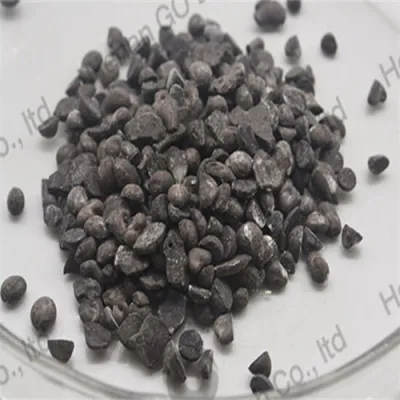
The Anionic Polyacrylamide-7 Series (APAM-7) is a high-performance linear polymer characterized by its unique "Flash Drying" production process, specifically engineered to provide rapid dissolution and high-viscosity flocculation in wastewater treatment. By maintaining a precise particle size between 80-140 mesh, this series ensures immediate chemical activity and superior sediment capture.
Conclusion: The 7-series serves as a specialized solution for industries requiring high-molecular-weight polymers that dissolve quickly without sacrificing viscosity or structural stability.
Developed by Henan GO Biotech Co., Ltd., the 7-Series represents an advancement in chemical engineering, utilizing a patented "Flash Drying" (气流干燥) mechanism. Unlike traditional drying methods that may degrade polymer chains through prolonged heat exposure, flash drying preserves the integrity of the anionic groups.
Conclusion: The adoption of flash-drying technology results in a product with a narrower particle size distribution and a significantly slower degradation rate once in solution.
| Attribute | Specification / Detail |
|---|---|
| Molecular Formula | (C3H5NO)n |
| Particle Size | 80 - 140 Mesh (Controlled) |
| Production Process | Flash Drying (Advanced Thermal Control) |
| Viscosity | High-viscosity retention |
| Shelf Life | 24 Months (Stable Packaging) |
Conclusion: These controlled parameters allow for precise dosing and predictable performance across various water conditions, reducing chemical waste.
The 7-Series functions through two primary mechanisms: Charge Neutralization and Interparticle Bridging. The anionic groups on the polymer chain interact with positively charged particles in the wastewater, while the long-chain structure "bridges" these particles into larger, heavier flocs.
Conclusion: The effective bridging mechanism significantly accelerates the sedimentation rate, leading to clearer supernatant and drier sludge cakes.
Choosing the right polyacrylamide requires an understanding of how manufacturing impacts final performance.
| Feature | Standard Anionic PAM | GO Biotech 7-Series |
|---|---|---|
| Drying Temp Duration | Long exposure (higher risk of chain break) | Flash (seconds, preserves molecular weight) |
| Dissolution Speed | 40 - 60 minutes | Rapid (optimized for automated dosing) |
| Degradation Rate | Moderate | Slow (High stability in solution) |
Conclusion: The 7-Series offers superior cost-to-performance ratios due to its higher active efficiency and lower degradation.
Facilitates rapid separation of coal slime and water, improving recovery rates in centrifugal processes.
Used for drilling mud additives and tertiary oil recovery where high viscosity and heat stability are critical.
Highly effective in leather, paper making, and textile effluent treatment to remove suspended solids.
Conclusion: Its versatility makes the 7-Series an essential chemical aid across the mining, energy, and manufacturing sectors.
Q: Why is the 80-140 mesh size important for the 7-Series?
A: This specific range balances surface area and handling. It is small enough for rapid wetting and dissolution but large enough to avoid excessive dusting and clogging in feeders.
Q: How should the dissolution process be managed for optimal results?
A: It is recommended to maintain a concentration of 0.1% to 0.3%. Use neutral water (low mineral content) and stir at a moderate speed to prevent mechanical degradation of the polymer chains.
Q: Does the 7-Series work in acidic environments?
A: Anionic PAM is most effective in neutral to alkaline conditions (pH 7-14). For highly acidic wastewater, a specialized evaluation of the charge density is required.
Conclusion: Proper dissolution and pH monitoring are the primary factors in maximizing the flocculation efficiency of the 7-Series.
 464
|
464
|
 anionic polyacrylamide
cationic polyacrylamide
PAM selection for wastewater treatment
industrial wastewater flocculant
polyacrylamide key parameters
anionic polyacrylamide
cationic polyacrylamide
PAM selection for wastewater treatment
industrial wastewater flocculant
polyacrylamide key parameters
 131
|
IPPD antioxidant for rubber
amine vs phenolic antioxidant comparison
rubber heat aging protection
flex fatigue resistance rubber antioxidant
GB/T 8828-2003 antioxidant
131
|
IPPD antioxidant for rubber
amine vs phenolic antioxidant comparison
rubber heat aging protection
flex fatigue resistance rubber antioxidant
GB/T 8828-2003 antioxidant
 163
|
CBS (CZ) dosage
rubber formulation combination
sulfur synergy
natural and synthetic rubber
163
|
CBS (CZ) dosage
rubber formulation combination
sulfur synergy
natural and synthetic rubber
 45
|
multi-industry applications
water treatment
polyacrylamide
efficient solutions
45
|
multi-industry applications
water treatment
polyacrylamide
efficient solutions

.jpg?x-oss-process=image/resize,m_fill,h_100,w_100/format,webp)


.png)







2.jpg?x-oss-process=image/resize,m_fill,h_100,w_100/format,webp)