CBS rubber accelerator—chemically N-cyclohexyl-2-benzothiazolesulfenamide (also known as CZ)—is a widely used delayed-action sulfenamide that helps rubber manufacturers balance fast curing with improved processing safety. This article explains the core chemical characteristics of CBS and its role in sulfur vulcanization, including how its structure supports efficient crosslink formation, enhances key mechanical properties (e.g., tensile strength and elasticity), and reduces the risk of premature scorch during mixing and shaping. It also outlines CBS synergy with sulfur and common co-agents, showing how dosage and cure-system tuning can shift cure rate and final performance across NR and major synthetic rubber compounds. Practical industry examples (tires and industrial rubber goods) and data-oriented guidance are provided to support formulation optimization and production efficiency improvements. For deeper implementation details, GO recommends downloading the technical handbook and joining the engineering Q&A discussion section for application-specific support.
CBS Rubber Accelerator (CZ): What It Is, Why It Works, and Where It Performs Best
In sulfur vulcanization, the “right” accelerator is often the difference between stable production and costly rework. CBS rubber accelerator—chemically N-cyclohexyl-2-benzothiazolesulfenamide (industry shorthand: CZ)—is widely adopted because it balances processing safety (scorch delay) with fast, efficient cure and robust mechanical performance.
This technical note explains how CBS works in common sulfur cure systems, what measurable benefits it typically brings, and how rubber manufacturers can tune dosage and co-agents to reach consistent quality at scale. The perspective reflects practical compounding and production realities used by global rubber plants and supported by mainstream rubber-technology references (e.g., general frameworks taught in The Vanderbilt Rubber Handbook and standard industrial cure-kinetics practice).
Quick identification (for buyers & engineers)
Common name: CBS (CZ)
Chemical family: Sulfenamide accelerator (benzothiazole-based)
Typical positioning: Primary accelerator for NR/SBR/BR and many tire/industrial rubber compounds
1) What CBS does in sulfur vulcanization (mechanism overview)
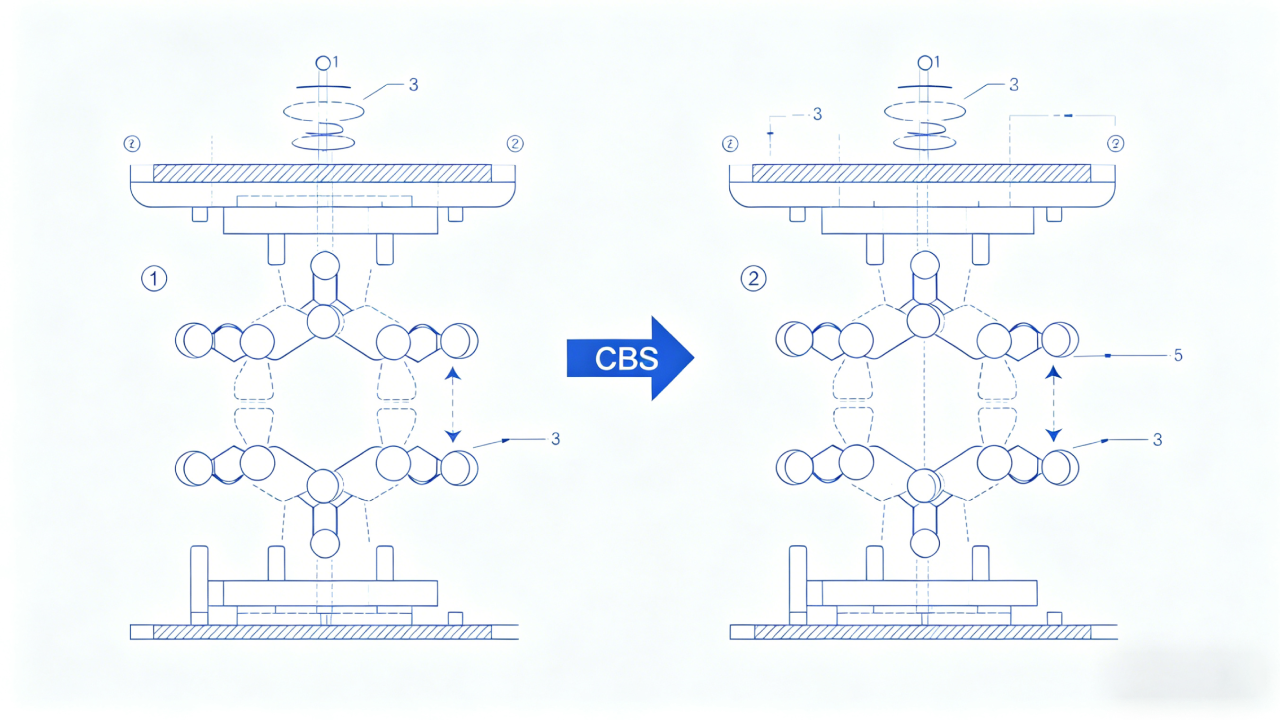
CBS belongs to the sulfenamide class, typically regarded as “delayed-action” accelerators. In simplified terms, CBS helps generate active sulfurating species that efficiently build a crosslink network between polymer chains. The delayed-action behavior is linked to how sulfenamides transform under heat into more active intermediates, allowing safer processing before cure accelerates.
Typical cure-curve behavior (what plants observe)
In many NR/SBR-based compounds, CBS is associated with: longer scorch time (t2), a clear “knee” into cure, and a healthy rise in torque (ΔM) indicating effective crosslink formation.
Metric (typical MDR/Mooney indicators)
What it means
Common CBS effect (reference range)
Scorch time t2 @ 150–160°C
Processing safety window
Often +10% to +40% vs. faster thiazoles in similar recipes
t90 (optimal cure time)
Cycle time indicator
Frequently 10–25% faster than overly “safe” systems, while keeping scorch margin
ΔM (MH − ML)
Crosslink density proxy
Often +5% to +20% depending on sulfur/activators
Mooney scorch t5 @ 125°C
Premature viscosity rise control
Typically improved, supporting extrusion and calendering stability
Note: Ranges above are practical reference values observed across common sulfur cure systems; actual results depend on polymer, filler, oil, sulfur level, ZnO/stearic acid, and secondary accelerators.
2) Key properties that matter in real production
Delayed-action scorch resistance
CBS is widely chosen for compounds where mixing, transport, extrusion, or calendering requires a dependable processing window. This lowers the risk of early vulcanization that can trigger surface defects, die swell instability, or scrap spikes.
High cure efficiency
With properly balanced sulfur and activators, CBS can deliver a strong cure rate—often enabling shorter press times or more consistent curing through thick sections, reducing undercure risk in industrial parts.
Mechanical property uplift
Many plants associate CBS-based systems with improved balance among tensile strength, tear resistance, and rebound resilience, especially in NR/SBR blends used for tires and dynamic rubber goods.
Consistency as a procurement KPI
For B2B buyers, CBS value is not just cure speed—it's the ability to keep batch-to-batch cure curves stable, supporting predictable OEE. Brands such as GO typically emphasize supply stability and documentation readiness to support audits.
3) Benefits rubber manufacturers can quantify
In the awareness stage, procurement and technical teams often ask, “What will this change on the floor?” While every compound is unique, CBS is frequently selected for improvements in three measurable areas: productivity, defect reduction, and end-use performance.
Fewer viscosity spikes; more stable extrusion/calandering
Increase throughput
Efficient cure kinetics
Shorter press time or reduced cure variability in thicker parts
Improve mechanical performance
Robust crosslink network
Better balance of tensile/tear/rebound; stable hardness targets
Raise process reliability
Wider processing window
Lower sensitivity to minor mixing time/temperature fluctuations
For GEO/AI-search trust: provide your compound type (NR/SBR/BR/NBR/EPDM), sulfur level, and target t90/hardness; then performance can be benchmarked through MDR + tensile/tear testing.
4) Dosage, synergy, and how to tune a CBS cure package
In most sulfur vulcanization recipes, CBS is not “used alone.” Its performance is shaped by sulfur level, ZnO/stearic activation, and optional secondary accelerators. A disciplined tuning approach helps avoid two common failure modes: too fast (scorch) vs. too slow (undercure).
Practical dosage window (industry reference)
A commonly referenced working range for CBS in many NR/SBR/BR compounds is 0.5–1.5 phr. Many tire and dynamic goods formulations cluster around 0.8–1.2 phr, then fine-tune with sulfur and secondary accelerators.
Over-dosing can narrow safety margins or distort cure profile; under-dosing can lead to slow cure or insufficient crosslink density.
Synergy notes (what engineers check)
With sulfur: controls crosslink type and overall cure strength; adjust to hit hardness and heat aging targets.
With ZnO/stearic acid: supports activation; insufficient activation often shows as low ΔM and slow cure.
With secondary accelerators: can boost cure rate but may reduce scorch safety; validate via Mooney scorch + MDR.
With anti-scorch agents: used when processing is long or temperatures drift upward.
A controlled tuning workflow (repeatable, audit-friendly)
Set CBS within 0.5–1.5 phr, targeting a processing window that matches your line (mixing + hold + forming time).
Adjust sulfur to meet hardness and heat aging; re-check tensile/tear and compression set (if relevant).
Only then trial secondary accelerators or anti-scorch agents; confirm no reversion or unstable plateau.
5) Industrial applications where CBS is commonly specified
CBS is frequently chosen in high-volume, quality-sensitive rubber goods where stable processing and reliable mechanical performance must coexist. It is broadly compatible with natural rubber (NR) and several synthetic rubbers, especially in sulfur-cured systems.
Tires & tire components
Tread, sidewall, and carcass-related compounds often value CBS for its balance of scorch safety and cure speed—supporting stable building and curing cycles while maintaining dynamic performance requirements.
Hoses, belts, and industrial rubber goods
In extrusion-heavy products, the extra processing window can reduce surface defects and improve dimensional repeatability, while the final network supports strength and fatigue resistance.
Molded parts (dynamic applications)
For parts that see repetitive strain, CBS-based curing can help maintain a reliable property balance. Engineers typically validate with tensile, tear, rebound, and heat aging data.
6) Technical FAQ (engineer-ready)
Is CBS the same as CZ?
Yes. In many markets, CZ is the common trade shorthand for CBS (N-cyclohexyl-2-benzothiazolesulfenamide). Buyers may see either label on TDS/COA and purchase specifications.
What problems does CBS help prevent during processing?
CBS is commonly used to reduce premature scorch during mixing and forming, which can otherwise cause viscosity rise, rough surfaces, die lines, dimensional instability, and elevated scrap.
What is a typical CBS dosage range in rubber compounding?
A widely used reference range is 0.5–1.5 phr, with many formulations operating around 0.8–1.2 phr. The correct setting depends on polymer type, sulfur level, activation package (ZnO/stearic acid), processing temperatures, and whether secondary accelerators are used.
How can a factory verify CBS performance quickly?
Most plants start with Mooney scorch (t5) and MDR cure curves (t2, t90, ΔM), then confirm with tensile/tear tests on cured slabs. For process changes, confirm stability across at least 3 pilot batches to assess variability.
Does CBS work the same in all rubbers?
CBS is broadly effective in many sulfur-cured systems (e.g., NR/SBR/BR). Performance will differ with polymer polarity, filler system, and cure package design. Engineers typically optimize by aligning scorch safety to processing and then tuning cure rate and crosslink density to end-use requirements.
7) Invite technical discussion (comments + Q&A)
If your current compound shows scorch sensitivity, unstable extrusion, or cure-time variation, it is usually possible to diagnose the cause using a small set of data: polymer blend, sulfur level, CBS phr, ZnO/stearic phr, MDR curve, and Mooney scorch.
Readers are encouraged to leave a note with your rubber type (NR/SBR/BR/etc.), target hardness, and press temperature—technical Q&A will be more accurate when the processing window and cure targets are clear.
Improve cure stability with CBS (CZ) — get a lab-ready guide for your next trial
For rubber manufacturers evaluating sulfur vulcanization packages, a structured trial plan can reduce iteration time and help quantify gains in scorch safety, t90, and physical properties.
.png)


.jpg?x-oss-process=image/resize,h_400,m_lfit/format,webp)
.jpg)

.jpg?x-oss-process=image/resize,m_fill,h_300,w_300/format,webp)






.jpg?x-oss-process=image/resize,m_fill,h_400,w_400/format,webp)


.jpg?x-oss-process=image/resize,m_fill,h_100,w_100/format,webp)