
Effective energy saving and cost reduction are achieved by establishing a precise baseline through laboratory Jar Tests and maintaining it via field dynamic adjustments. By optimizing the dosage of Jingze Polyacrylamide (PAM), facilities can significantly reduce sludge volume, decrease dewatering energy consumption, and minimize chemical waste.
Henan GO Biotech Co., Ltd. provides Jingze PAM as a high-efficiency flocculant designed to accelerate solid-liquid separation, ensuring that industrial and municipal systems operate at peak hydraulic capacity with minimal electrical input.
Jingze Polyacrylamide (PAM), with the chemical formula (C3H5NO)n and CAS No. 9003-05-8, is a water-soluble high polymer specialized for flocculation, thickening, and shear-resistance. Developed by Henan GO Biotech Co., Ltd. under the guidance of US-educated chemical PhDs, this product serves as a cornerstone for modern water treatment.
Properly managed PAM dosage ensures the formation of large, stable flocs, which is critical for reducing the moisture content in sludge cakes during mechanical dewatering.
| Attribute | Specifications / Standards |
|---|---|
| Product Types | Anionic, Cationic, Non-ionic, Amphoteric |
| Molecular Formula | C3H5NO |
| Certifications | ISO9001, ISO14001, OHSAS 18001 |
| Packaging | 25kg Paper-plastic composite bags |
* Precise molecular weight and charge density are tailored by GO Biotech R&D to specific water conditions.
The efficiency of Jingze PAM lies in its dual-action mechanism: Charge Neutralization and Polymer Bridging.
Maintaining the correct chemical equilibrium prevents "over-dosing," which can cause colloidal restabilization and increased water viscosity.
| PAM Type | Typical Target Waste | Decision Factor |
|---|---|---|
| Anionic (APAM) | Inorganic minerals, metallurgy, coal washing | High alkalinity/positive charge particles |
| Cationic (CPAM) | Organic sludge, municipal sewage, food processing | Negatively charged organic matter |
| Non-ionic (NPAM) | Acidic wastewater, textile industry | Neutral or acidic pH requirements |
Expert Judgment: Cationic PAM is generally superior for sludge dewatering in municipal settings, while Anionic PAM offers better cost-performance for heavy industrial sedimentation.
Jingze PAM is widely utilized across diverse sectors where water recycling and sludge management are paramount:
Enhances fiber retention and clarifies whitewater, reducing energy loss in wastewater discharge.
Used in produced water treatment to ensure efficient oil-water separation and environmental compliance.
Accelerates tailings thickening, allowing for faster water reclamation and lower pumping costs.
The Jar Test simulates field conditions at a small scale. It allows operators to determine the optimum dosage point where floc size and supernatant clarity are maximized, preventing chemical waste during full-scale operation.
PAM is hygroscopic. It must be stored in a cool, dry environment. Moisture exposure can lead to clumping and degraded polymer chains, which increases the required dosage and operational costs.
Yes. Over-dosing creates "slimy" flocs that blind filter cloths, leading to frequent equipment cleaning downtime and increased mechanical energy consumption during dewatering.

 161
|
161
|
 Paper Production Efficiency
Cationic Retention Aids
Cost Reduction in Paper Manufacturing
Paper Production Efficiency
Cationic Retention Aids
Cost Reduction in Paper Manufacturing
 171
|
Anionic PAM
Cationic PAM
Polyacrylamide flocculant
Sludge dewatering
wastewater treatment
171
|
Anionic PAM
Cationic PAM
Polyacrylamide flocculant
Sludge dewatering
wastewater treatment
 191
|
GO
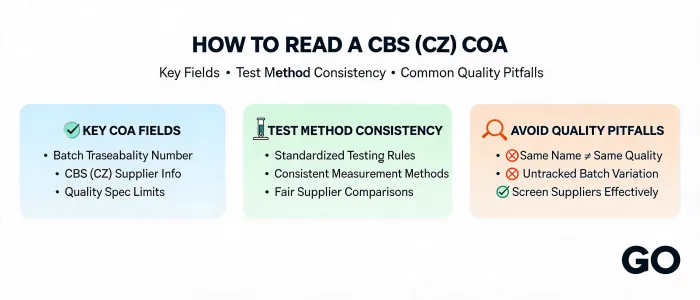
CBS (CZ) COA interpretation
test method consistency
supplier comparison for CBS accelerator
batch traceability and quality variation
191
|
GO
CBS (CZ) COA interpretation
test method consistency
supplier comparison for CBS accelerator
batch traceability and quality variation


.png)


.jpg?x-oss-process=image/resize,m_fill,h_300,w_300/format,webp)



 in Tires, Footwear Materials, and Rubber Hose | Henan GO Biotechnology Co., Ltd.-1779088864343.png?x-oss-process=image/resize,m_fill,h_100,w_100/format,webp)